
Why Satpura Tiger Reserve Is India’s Most Rewarding Wildlife Photography Destination — And the Best Kept Secret Near Pachmarhi
The Sound That Changes Everything
A langur screams from the canopy above. Thirty metres away, a spotted chital freezes mid-stride, barks once — sharp, urgent, directional.
Your naturalist barely turns. He leans toward you and whispers: “Tiger. Moving left. Towards the waterhole. Camera up.”
You haven’t seen it yet. But your finger is already on the shutter.
This is not luck. This is Satpura — and this is exactly why serious wildlife photographers, seasoned naturalists, and adventure-hungry families are quietly ditching the overcrowded circuits and choosing Pandav hotel & resorts at Satpura Tiger Reserve as their base in the heart of Madhya Pradesh.
If you’ve been searching for the best pachmarhi places to stay with genuine wild India at your doorstep, you’ve just found your answer.
Why Satpura? 107 Years of Wild History
Satpura National Park was established in 1981, but its conservation story stretches back over a century. The broader Satpura landscape — covering over 1,427 sq km of core zone — was declared a UNESCO Biosphere Reserve in 1999, making it one of only a handful of tiger reserves in the world with that designation.
What makes it exceptional isn’t just the tigers. It’s the layered biodiversity — a mosaic of sal, teak and bamboo forest where over 1,427 plant species, 50 mammal species and 300+ bird species have been recorded. The Denwa river cuts through the landscape, creating wetland edges where the forest meets the water and wildlife congregates with extraordinary predictability.
This is the stage. Pandav Hotels & Resorts sits at its centre.
The Birds That Steal the Show: Indian Pitta, Skimmer & More
Before the big cats arrive on your checklist, the birds at Satpura will stop you cold.
The Indian Pitta (Pitta brachyura) — nicknamed the “nine-coloured bird” — is one of the most photographed species in the reserve. With nine distinct colours on a sparrow-sized body, it winters in the Satpura forests between October and April, drawing birders from across the world. Indian Pitta was first formally described by Linnaeus in 1766 and remains one of India’s most sought-after bird sightings.
The Indian Skimmer (Rynchops albicollis) is rarer still — listed as Vulnerable on the IUCN Red List, with a global population estimated at just 6,000–10,000 individuals. Along the Denwa backwaters, Satpura is one of the last reliable places in Central India to spot this extraordinary bird skimming the river surface at dawn, its lower mandible slicing the water with geometric precision.
Add to this the Oriental Pied Hornbill, Crested Serpent Eagle, Flamingo and Spoonbill along the backwaters — and your lens will be working before the jeep engine is cold
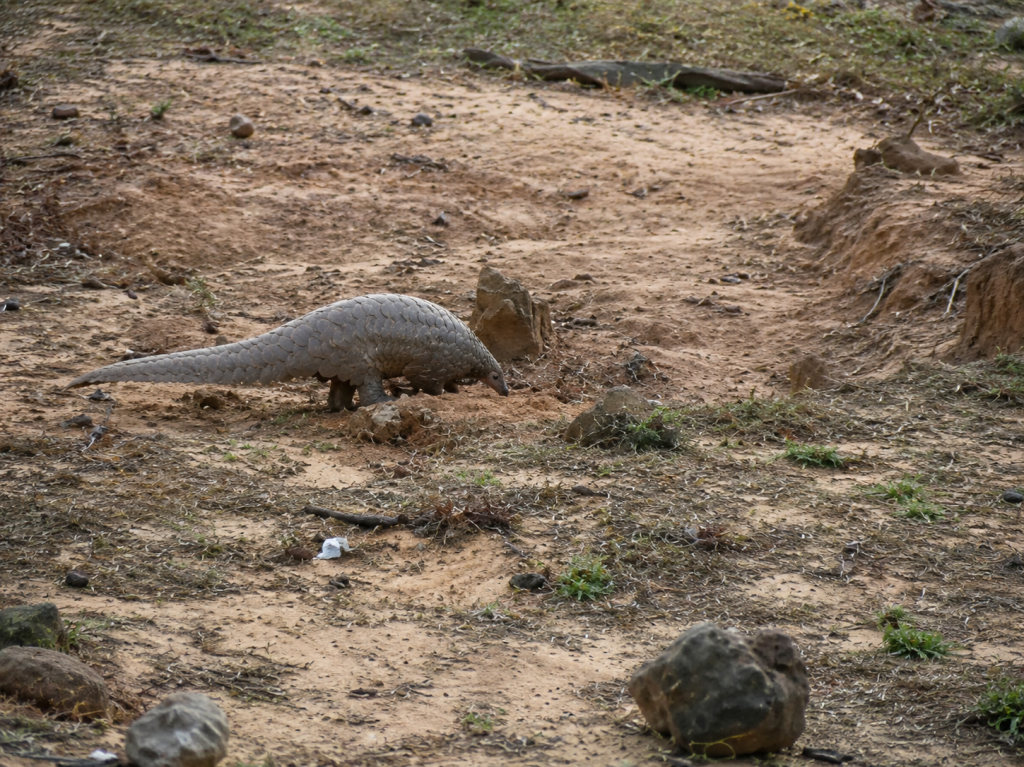
A Pangolin Sighting: The Rarest Gift in the Jungle
Here is a number that stops most wildlife enthusiasts: pangolins are trafficked more than any other wild mammal on earth, with over 1 million individuals poached in the last decade globally.
In Satpura, they still exist in the wild.
The Indian Pangolin (Manis crassicaudata) is nocturnal, solitary, and supremely elusive. Most wildlife travellers complete a lifetime of safaris without a single sighting. At Satpura, the forest structure and low safari pressure create conditions where — with an experienced naturalist and early morning luck — guests occasionally witness this armoured mammal shuffling through the undergrowth.
There is no trophy photograph in Indian wildlife more exclusive. Not even the tiger.
Tigers Near Waterholes: Why Summer Heat Is Your Friend
Between April and June, as temperatures in Central India climb past 42°C, something counterintuitive happens in Satpura: the sightings get better.
Vegetation thins. Water becomes scarce and concentrated. Tigers — large animals with high cooling demands — return to waterholes, streams and the edges of the Denwa with increasing predictability. Satpura’s 80–85% tiger sighting probability in summer is among the highest of any reserve in India.
For photographers, the summer waterholes offer something even more valuable: context. A tiger cooling in a shallow stream, surrounded by dry teak forest, golden afternoon light cutting across the surface — it is not a sighting. It is a frame.
The buffer zone at Satpura permits all photography formats — including long lenses, tripod rigs and professional equipment — a freedom rare among India’s tiger reserves
Leopards, Sloth Bears & the Art of the Alarm Call
Leopard sighting probability at Satpura: 60–70%. For a species that most reserves struggle to show guests even once in five visits, this number is extraordinary.
Sloth bears: 70% sighting probability. Satpura’s forest structure — rocky outcrops, dense undergrowth, termite-rich soil — is ideal sloth bear habitat. Mothers with cubs on their backs remain one of the most emotionally powerful wildlife encounters in India.
But the real skill — the thing that separates a Satpura safari from anywhere else — is learning to read the jungle’s own alarm system.
Every species communicates danger differently:
- Langur monkey: Sharp bark from height = aerial or approaching ground predator
- Chital deer: Staccato bark, tail flagging = ground predator, close proximity
- Sambar deer: Deep, resonant bell-call = large predator, likely tiger or leopard
- Jungle Fowl: Sudden explosive flush = predator passed at ground level
Direction, frequency, and species combination allow an experienced naturalist to triangulate a predator’s position, movement, and likely destination — sometimes 10 to 15 minutes before the animal becomes visible.
This is the knowledge Pandav’s naturalists share with guests. Not as lecture, but in real time, on safari, whispered in the jeep as the forest tightens around you.
The Pandav Advantage: Why Our Guests See More
Here is something no other resort near Pachmarhi can offer.
Pandav Hotels & resorts dedicated naturalist team maintains an active, real-time sighting network across the reserve. When credible intelligence arrives — a forest guard’s report, a fresh pugmark trail, an alarm call cluster noted at dawn — Pandav guests are notified before the safari window opens.
This is not a guarantee. Wildlife is wild. But it is the closest thing to a competitive edge that exists in ethical wildlife tourism.
The result: guests staying at Pandav consistently report higher quality sightings — not just more sightings, but better-positioned, better-lit, longer encounters — than visitors arriving on day trips or staying at distant accommodation.
If you are serious about wildlife photography, or if this is your family’s first big jungle experience and you want it to be unforgettable — location and naturalist quality are everything.
Pandav is not the closest option when you search for hotels to stay in Pachmarhi or complete your online hotel booking in Pachmarhi. It is, however, the right one
Plan Your Visit: Getting Here & Staying at Pandav
Satpura Tiger Reserve sits in Hoshangabad district, Madhya Pradesh, approximately 190 km from Bhopal and within comfortable reach of Pachmarhi — India’s only hill station in Madhya Pradesh. Pachmarhi itself sits at 1,067 metres elevation and has been a UNESCO Biosphere Reserve since 1999.
Among the top resorts in Madhya Pradesh for a combined hill station and tiger reserve experience, Pandav hotels & resorts offers the rare combination of expert naturalist-led safaris, intimate camp-style luxury, and direct proximity to the reserve.
Safari windows: Morning (6:00–10:00 AM) and Evening (3:00–6:30 PM). Both windows are productive. Both are beautiful.
Conclusion: The Shot You’ll Never Forget
The chital barks again. Your naturalist nods. And then — out of the teak, striped and silent — the tiger steps into the light.
Your shutter fires.
This is what Satpura delivers when you arrive prepared, stay close, and trust the naturalist who has spent years learning every alarm call, every trail, every waterhole.
Planning your trip to Satpura is easier than you think. You can check travel options, compare routes from your city, and explore packages directly on MakeMyTrip — India’s most trusted travel booking platform to plan your journey to Madhya Pradesh with ease.
Read in our Satpura Series: Hidden wildlife of Satpura — Why Satpura Is Unlike Anything You’ve Experienced
Whether you’re planning a family adventure, a dedicated photography expedition, or simply searching for the finest pachmarhi places to stay with real jungle access — Pandav hotels & resorts at Satpura is your answer.
Book your safari experience → | Online hotel booking in Pachmarhi region is made simple.
FAQ
Q1 Guest: “I’ve been to African safaris. Will I be disappointed in Satpura?” How do you manage expectations and highlight unique strengths?
Satpura is very different from African safaris — and that’s exactly its charm. Instead of vast open grasslands, Satpura offers intimate wilderness experiences like boat safaris, walking safaris in buffer zones, rich birdlife, sloth bear sightings, and raw jungle exploration. It’s less about scale and more about connection, silence, and immersive wildlife moments.
Q2 What is the estimated tiger population in Satpura and how does sighting probability compare to Kanha or Bandhavgarh?
Satpura Tiger Reserve is estimated to have around 50–60 tigers across its landscape. Compared to parks like Kanha National Park or Bandhavgarh National Park, tiger density in Satpura is lower, so sightings are less predictable and more natural. However, that’s what makes Satpura special — the experience feels raw, uncrowded, and truly wild. When a tiger sighting happens here, it feels earned, intimate, and incredibly rewarding.
Q3 Why is Satpura famous for sloth bear sightings compared to other reserves?
Satpura Tiger Reserve is especially famous for sloth bear sightings because it has one of the highest sloth bear densities in India. The reserve’s rocky terrain, dense forests, termite-rich habitat, and relatively low safari pressure create ideal conditions for them to thrive. Unlike many other reserves where sightings are rare, sloth bears are frequently spotted here, particularly during early morning and evening safaris, making Satpura a dream destination for wildlife enthusiasts and photographers.